

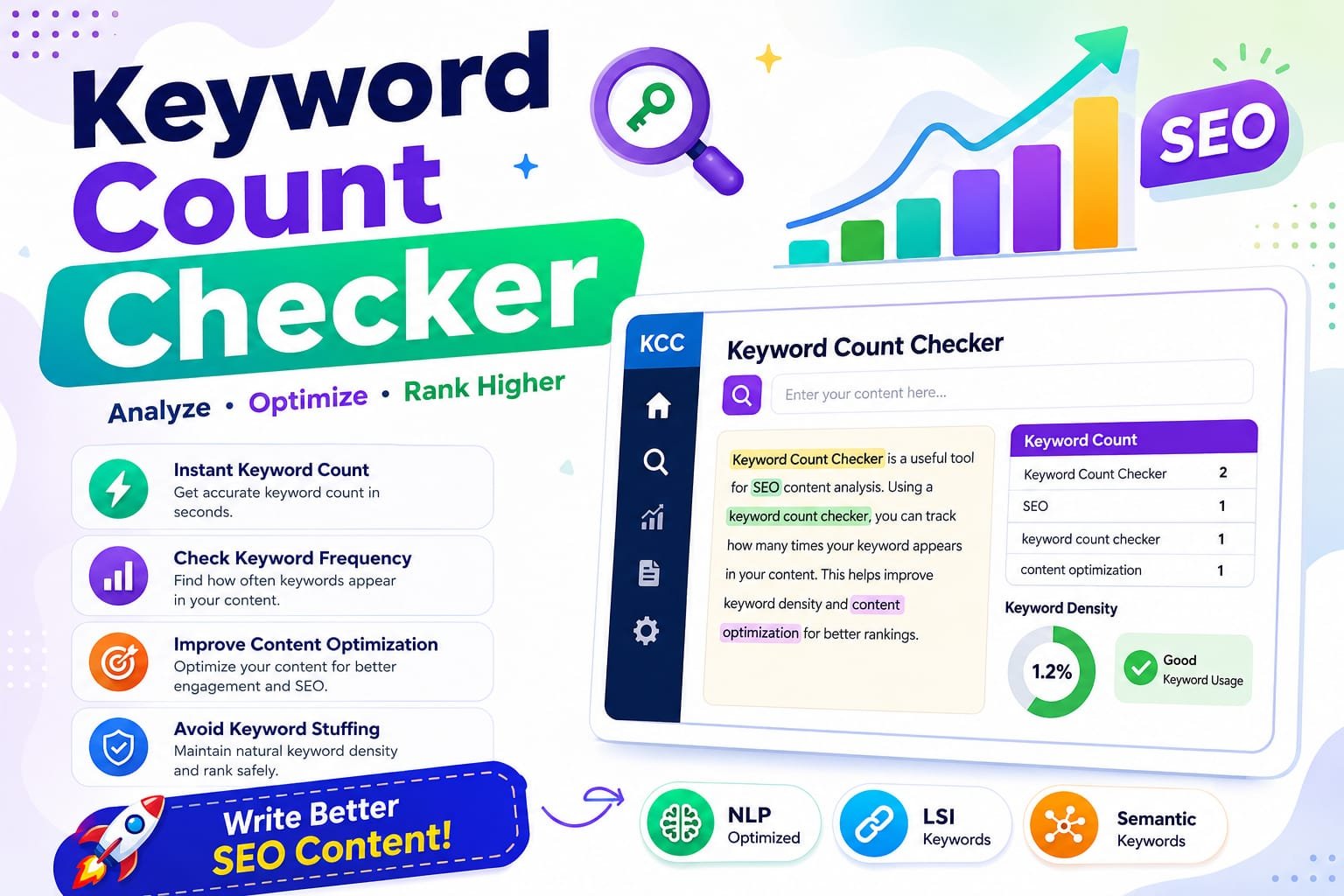
What Is a Keyword Count Checker?
A keyword count checker analyzes written content and calculates how many times particular words or phrases appear. Instead of searching through an article manually, you can enter your text and quickly identify keyword frequency, repetitions, and sometimes keyword density. This makes content optimization faster and more practical.
For SEO professionals, keyword counting provides useful data without replacing human judgment. A page targeting “keyword research,” for example, should naturally discuss related concepts such as search volume, search intent, long-tail keywords, SERPs, content strategy, and topic relevance rather than repeatedly inserting the same phrase.
- 🔎 Counts exact keywords
- 📊 Measures keyword frequency
- 📝 Reviews written content
- 🎯 Supports SEO optimization
- ⚡ Saves manual effort
- 🧠 Helps understand relevance
- 📈 Supports content analysis
- ✨ Improves optimization workflow
Why Keyword Counting Matters for SEO
Keyword frequency can reveal whether an important topic is sufficiently represented in your article. If a primary keyword appears only once in a long page, search engines and readers may have difficulty understanding the page’s central subject. Conversely, excessive repetition can make content sound unnatural and reduce readability.
A keyword count checker helps create a balanced approach. Instead of chasing an arbitrary density percentage, focus on satisfying search intent and covering the subject comprehensively. Include synonyms, related phrases, entities, NLP keywords, and semantically connected terms where they genuinely improve the reader’s understanding.
- 🎯 Check primary keywords
- 🧩 Find related terms
- 🧠 Strengthen topical relevance
- 📚 Expand subject coverage
- 🚫 Avoid keyword stuffing
- ✍️ Improve natural writing
- 🔗 Support semantic SEO
- 📈 Build content depth
How Does a Keyword Count Checker Work?
Most keyword counting tools use text-processing methods to scan content and identify matching words or phrases. Depending on the tool, you may receive an exact count, percentage-based keyword density, word count, phrase frequency, or a breakdown of frequently used terms. Some advanced platforms also analyze readability and related keywords.
For example, if your article contains the phrase “keyword count checker” 12 times within 2,000 words, the tool can identify that frequency instantly. More sophisticated analysis can distinguish individual words from multi-word phrases and help you compare primary keywords with supporting semantic vocabulary.
- ⚙️ Scans your text
- 🔢 Counts keyword occurrences
- 📐 Calculates density
- 🔤 Detects phrases
- 📄 Processes long content
- 🧮 Compares word frequency
- 🧠 Identifies text patterns
- ⏱️ Delivers quick results
Keyword Density vs. Keyword Count
Keyword count refers to the number of times a keyword appears, while keyword density expresses that number as a percentage of total words. For example, if a keyword occurs 10 times in a 1,000-word article, its basic density is 1%. These metrics are related but should not be treated as identical.
There is no universal keyword-density percentage that guarantees rankings. Search engines increasingly understand natural language, entities, context, and user intent. A better strategy is to mention the primary topic naturally while covering related questions and concepts thoroughly. Quality, usefulness, originality, and relevance should remain the priorities.
- 🔢 Count exact occurrences
- 📐 Understand percentages
- ⚖️ Compare frequency
- 🚫 Avoid over-optimization
- 🗣️ Keep language natural
- 🎯 Match search intent
- 🧠 Add contextual terms
- ✨ Prioritize usefulness
NLP, LSI, and Semantic Keywords
NLP keywords are words and phrases that help search systems interpret the meaning of content. LSI keywords are commonly used to describe related terms, although modern SEO discussions often use “semantic keywords” more accurately. For a page about keyword research, related concepts might include search queries, SERP analysis, keyword difficulty, competitors, and long-tail variations.
A keyword count checker can help you notice whether important supporting vocabulary appears naturally throughout an article. However, you should never add related terms simply to increase a score. Semantic optimization works best when terminology naturally reflects the subject and answers the questions users actually have.
- 🧠 Use NLP terminology
- 🔗 Add semantic relationships
- 🔎 Include related phrases
- 📚 Cover subtopics
- 🎯 Reflect search intent
- ✍️ Write naturally
- 🌐 Strengthen topical authority
- 💡 Answer user questions
How to Use a Keyword Count Checker Effectively
Start by writing useful content around a clearly defined topic and search intent. Then paste the completed draft into your keyword count checker. Review your primary keyword, important secondary phrases, repeated terms, and overall word frequency. Use the results to identify obvious gaps or unnatural repetition rather than mechanically editing every occurrence.
For competitive SEO, compare your content with high-quality pages covering the same topic. Look for concepts they explain that you have missed. This approach is more valuable than simply copying their keyword frequency. Your objective is to create a more complete and helpful resource while maintaining natural language and a strong user experience.
- 📝 Write before optimizing
- 🔍 Analyze keyword frequency
- 🎯 Identify content gaps
- 🧹 Remove unnecessary repetition
- 📊 Review supporting terms
- 🧠 Compare topical coverage
- 👥 Prioritize readers
- 🚀 Refine strategically
Common Keyword Counting Mistakes to Avoid
One common mistake is believing that more keyword mentions automatically produce better rankings. Repeating a phrase excessively can make an article awkward and may resemble keyword stuffing. Another mistake is focusing entirely on exact-match terms while ignoring synonyms, related entities, questions, and the broader topic.
Avoid optimizing exclusively for a tool-generated score. A page can have excellent keyword statistics and still provide little value. Tools should support your editorial decisions, not control them. Your content should be accurate, readable, original, useful, and aligned with what users expect when they enter a search query.
- 🚫 Don’t stuff keywords
- 📉 Don’t chase density
- 🧩 Don’t ignore synonyms
- 🤖 Don’t write for bots
- 👥 Don’t forget readers
- 📚 Don’t overlook subtopics
- 🔄 Don’t repeat unnecessarily
- 🎯 Don’t ignore intent
Best Practices for Keyword Count Checker Tools
Use keyword counting as one part of a complete content optimization process. Begin with keyword research, identify the primary search intent, create a useful outline, write naturally, and then analyze keyword frequency. After that, review headings, internal links, readability, semantic coverage, factual accuracy, and overall usefulness before publishing.
Whether you are creating a blog post, product description, landing page, or educational guide, consistency matters more than chasing a perfect number. A practical workflow can combine a keyword counter with grammar checking, plagiarism review, SERP research, analytics, and editorial review to produce stronger content.
- 🛠️ Choose reliable tools
- 🔍 Check important phrases
- 🧠 Review semantic coverage
- ✍️ Edit naturally
- 📱 Check readability
- 🔗 Improve internal linking
- 📊 Monitor performance
- 🚀 Update content regularly
Frequently Asked Questions About Keyword Count Checker
What is a keyword count checker?
A keyword count checker is a tool that counts how frequently a specific word or phrase appears in a piece of content. Many tools also calculate keyword density and total word count, making them useful for SEO content analysis.
What is a good keyword density?
There is no single ideal keyword density that guarantees rankings. Instead of targeting a fixed percentage, use your primary keyword naturally and make sure the article comprehensively addresses the searcher’s intent.
Can keyword counting improve Google rankings?
Keyword counting itself does not improve rankings. It can help you identify underuse or excessive repetition, while comprehensive, useful, relevant, and well-structured content can contribute to better search performance.
Should I use LSI keywords?
You can naturally include related terminology and semantic concepts that help explain your topic. For example, a keyword-counting article can discuss keyword density, search intent, SEO content, keyword frequency, NLP, and semantic relevance.
Can a keyword checker detect keyword stuffing?
Some advanced tools may flag unusually high keyword frequency or density. However, human review remains important because natural language varies significantly depending on the subject, writing style, and content length.
Is a keyword count checker useful for beginners?
Yes. Beginners can use one to understand how often target terms occur without manually searching through an article. It provides a straightforward introduction to keyword frequency and basic on-page SEO analysis.
Can I use a keyword checker for long-form content?
Yes. Keyword counting is particularly useful for long-form articles because manually tracking repeated terms becomes difficult as the document grows. The tool can quickly provide frequency information across the entire text.