

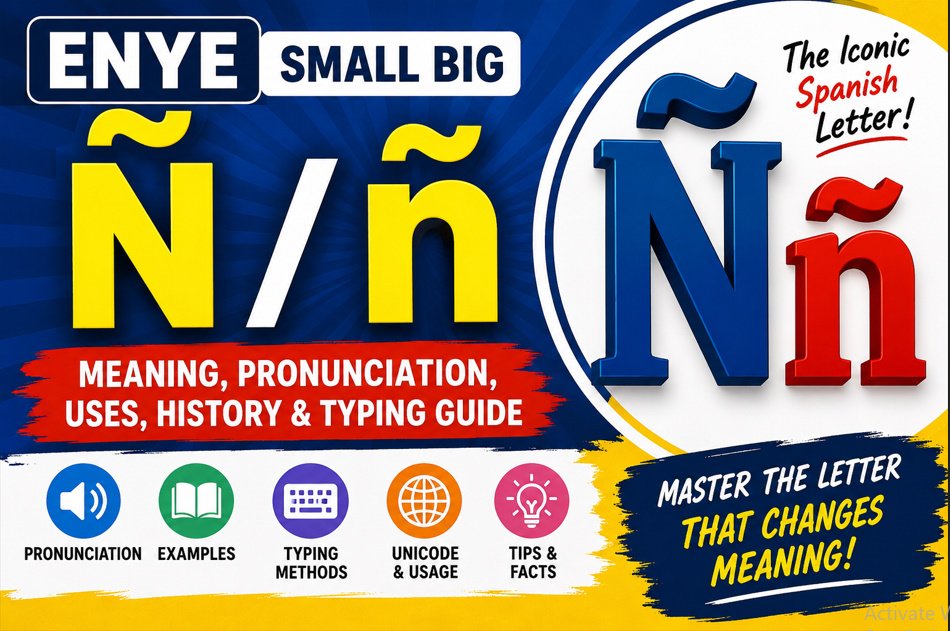
Enye Small Big Ñ / ñ: A Complete Beginner’s Guide
The Enye Small Big Ñ / ñ is one of the most distinctive letters found in the Spanish language. Although it resembles the English letter N, the tilde (~) placed above it completely changes both its pronunciation and meaning. Because of this, Ñ is treated as an independent alphabet letter rather than a variation of N.
Millions of Spanish speakers use Ñ and ñ every day in books, newspapers, official documents, websites, and conversations. Learning how to recognize, pronounce, and type this letter helps students, travelers, language learners, and professionals communicate more accurately.
Understanding the Difference Between Ñ and N
Many beginners believe that Ñ is simply a decorative version of the English N. In reality, the two letters represent completely different sounds. Substituting N for Ñ often changes the meaning of an entire word, which can create confusion during reading and writing.
For example, the Spanish words ano and año have entirely different meanings because one contains N while the other contains Ñ. This simple example highlights why the Enye plays such an important role in accurate communication.
Key Points
- Ñ is its own alphabet letter.
- N and Ñ sound different.
- Word meanings can change.
- Used throughout Spanish.
- Common in names.
- Common in places.
- Used in education.
- Important for grammar.
- Appears in dictionaries.
- Essential for correct spelling.
The Fascinating Story Behind Enye
Centuries ago, handwritten manuscripts required scribes to save space while copying books. Instead of writing two consecutive Ns, they wrote a smaller N above another N. As handwriting styles evolved, this small letter gradually became the familiar tilde that appears above Ñ today.
Eventually, Spanish scholars officially recognized the character as a separate letter. It became one of the strongest visual symbols of the Spanish language and continues to represent its rich linguistic heritage across the world.
Key Points
- Created in medieval Spain.
- Developed from double N.
- Began as handwriting shorthand.
- Saved writing space.
- Tilde evolved naturally.
- Officially adopted later.
- Represents Spanish history.
- Used for hundreds of years.
- Preserved by language institutions.
- Famous worldwide.
How to Say Enye Correctly
The pronunciation of Ñ may seem unusual at first, but it quickly becomes natural with practice. It produces a soft “ny” sound similar to the one heard in the English word “canyon,” although the Spanish version is smoother and slightly shorter.
Listening to native speakers and repeating common vocabulary is one of the fastest ways to master the sound. Correct pronunciation also helps improve listening comprehension when speaking with Spanish speakers.
Key Points
- Sounds like “ny.”
- Softer than English.
- Different from N.
- Easy to practice.
- Common in conversation.
- Appears in greetings.
- Used in children’s words.
- Important for fluency.
- Helps listening skills.
- Improves pronunciation.
Everyday Words That Include Ñ
Once you begin learning Spanish, you quickly discover how frequently the Enye appears in everyday vocabulary. From family members to common places and daily activities, this letter is found in words that people use regularly.
Popular examples include niño, niña, mañana, señor, señora, baño, España, año, piñata, and sueño. Recognizing these words makes reading and speaking much easier.
Key Points
- Niño
- Niña
- Año
- Mañana
- Señor
- Señora
- Baño
- Sueño
- Piñata
- España
Different Ways to Type Ñ on Devices
Modern technology makes typing Ñ extremely convenient. Whether using a desktop computer, laptop, smartphone, or tablet, several keyboard shortcuts and built-in language options allow users to insert the character instantly.
Many online text generators also include dedicated buttons for copying both uppercase Ñ and lowercase ñ. These tools are especially useful when working on shared computers or keyboards without Spanish layouts.
Key Points
- Windows keyboard shortcuts.
- Mac keyboard shortcuts.
- Android keyboard support.
- iPhone keyboard support.
- Copy-and-paste method.
- Unicode compatible.
- HTML compatible.
- Online generators available.
- Language settings help.
- Easy across devices.
Why Enye Matters in the Digital World
The internet connects people from many languages and cultures. Properly displaying Ñ ensures that names, addresses, educational materials, and official records remain accurate. Modern websites, databases, and software rely on Unicode to preserve this important character.
Search engines also recognize correctly written Spanish words containing Ñ. Using the proper letter improves readability, professionalism, and search accuracy for multilingual websites and digital content.
Key Points
- Unicode supported.
- UTF-8 compatible.
- Works in HTML.
- Used in websites.
- Supports databases.
- Appears in apps.
- Used in software.
- Search engine friendly.
- Prevents text errors.
- Supports multilingual content.
Practical Uses of Enye Small Big Ñ / ñ
Beyond language learning, the Enye appears in passports, legal documents, educational certificates, business records, tourism materials, and digital communications. Correct usage helps preserve identities and prevents spelling mistakes in official information.
Students, teachers, translators, content creators, software developers, and travelers all benefit from understanding when and how to use Ñ correctly. Its importance extends well beyond classrooms into everyday professional life.
Key Points
- School assignments.
- Travel documents.
- Passports.
- Government records.
- Business documents.
- Language learning.
- Translation work.
- Website development.
- Academic writing.
- International communication.
Final Thoughts on Enye Small Big Ñ / ñ
The Enye is more than a unique-looking character—it represents the identity, history, and pronunciation of the Spanish language. Understanding its purpose helps readers appreciate the richness of Spanish while improving their own language skills.
Whether you are learning Spanish for education, travel, business, or personal interest, mastering Enye Small Big Ñ / ñ is a valuable achievement. Once you understand its pronunciation, history, and typing methods, using this remarkable letter becomes simple and natural.
Key Points
- Unique alphabet letter.
- Rich historical background.
- Essential pronunciation.
- Easy to type.
- Common in Spanish.
- Useful worldwide.
- Improves communication.
- Supports correct spelling.
- Important in technology.
- Worth learning for everyone.
Conclusion
The Enye Small Big Ñ / ñ continues to be one of the most recognizable symbols of the Spanish language. From its medieval origins to its role in modern digital communication, this letter has maintained its importance across generations. Learning how to pronounce, type, and correctly use Ñ strengthens both written and spoken Spanish.
Whether you are a beginner or an experienced language learner, understanding this remarkable letter opens the door to more accurate communication and a deeper appreciation of Spanish culture.